The Top 5 Fire Alarm and Sprinkler Deficiencies Found in Southern California Properties
As a commercial property manager in Southern California, you know that a fire marshal inspection is not a matter of if, but when. While you may feel prepared, the reality is that most inspection failures stem from a small handful of common, preventable issues. These aren't complex technical failures; they are the slow-drip problems that arise from deferred maintenance, minor tenant alterations, and a lack of proactive oversight.
This guide is not about pointing fingers. It’s about pulling back the curtain on the five most common fire alarm and sprinkler deficiencies that our technicians find every day in commercial buildings across Orange County, Los Angeles, and the Inland Empire. Understanding these issues is the first step to ensuring your property is not just compliant, but genuinely safe.
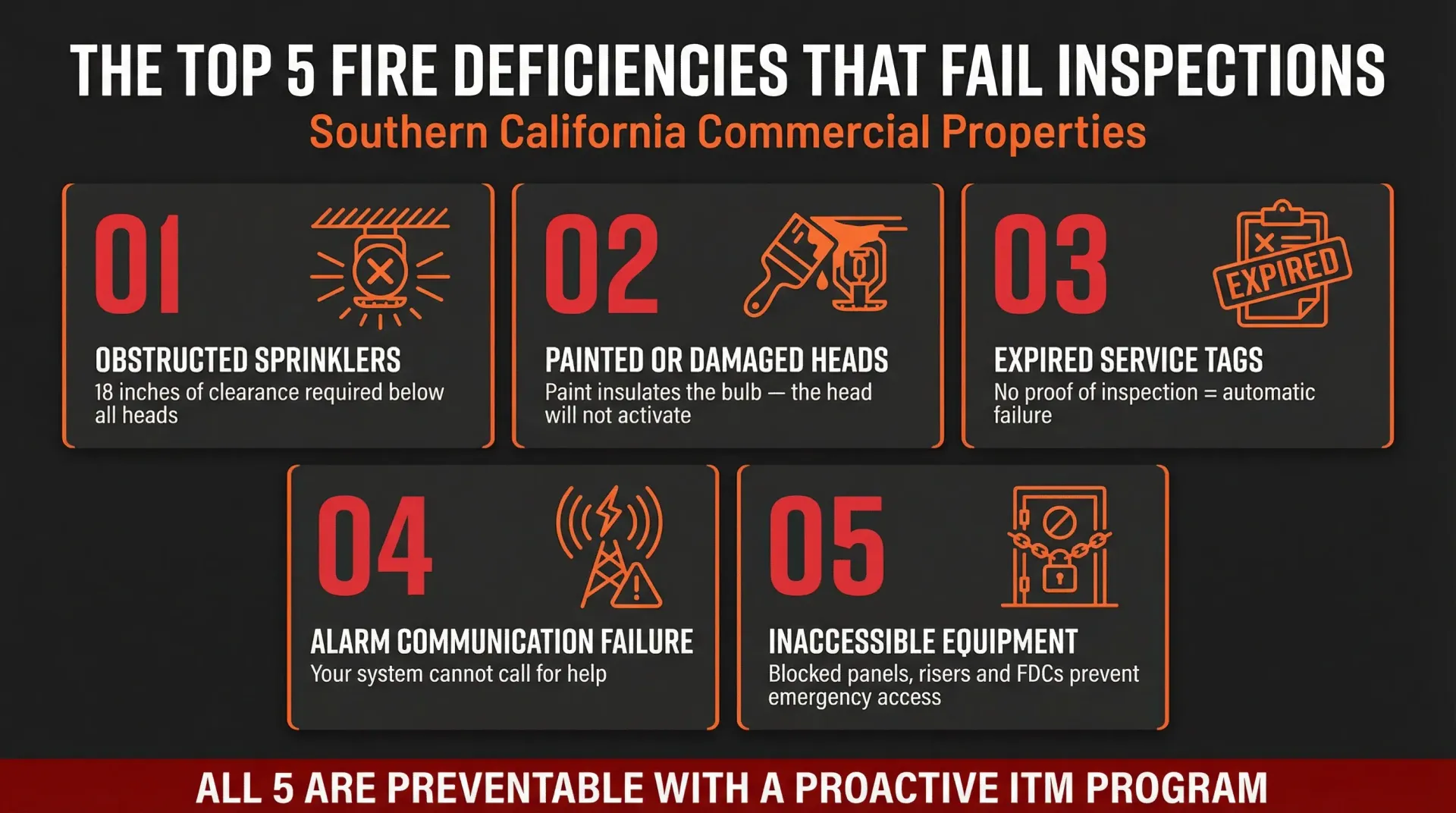
Deficiency #1: Obstructed Fire Sprinklers
This is, without a doubt, the most frequent and easily corrected deficiency found during an inspection. It’s also one of the most dangerous.
The Problem: According to
NFPA 25, all sprinkler heads must have a minimum of
18 inches of clear space below them to allow for proper water distribution. When storage is stacked too high in a warehouse, when decorations are hung from pipes in a retail space, or when new office partitions are built without considering sprinkler locations, this clearance is violated. The sprinkler head cannot create the umbrella-shaped spray pattern it was designed for, rendering it ineffective.
| Issue | Solution |
|---|---|
| High-piled storage | Clearly mark the 18-inch clearance line on walls and racking. |
| Decorations/Signage | Establish a strict policy against hanging anything from sprinkler pipes. |
| Tenant Improvements | Review all proposed tenant alterations to ensure they do not interfere with existing fire protection. |
Deficiency #2: Painted or Damaged Sprinkler Heads
This issue is a close second to obstructions and is often caused by well-intentioned but uninformed maintenance staff or contractors.
The Problem: A fire sprinkler head is a delicate, heat-activated device. The red or orange bulb is a glass vial containing a heat-sensitive liquid. When painters or maintenance staff accidentally cover the head with even a thin layer of paint, it insulates this bulb, delaying or preventing its activation. Similarly, a sprinkler head that has been bent, dented, or heavily corroded will not function as intended.
The Fix:
- Never paint a sprinkler head.
If a head has been painted, it must be replaced by a licensed professional. There is no way to safely remove the paint.
- Protect sprinkler heads during any renovation or construction. Use approved plastic covers to shield them from paint, dust, and physical damage.
- Conduct regular visual inspections. Look for any signs of corrosion, damage, or paint. If you see a problem, schedule a repair immediately.
Deficiency #3: Missing or Expired Inspection & Service Tags
This is the silent killer of compliance. Your equipment might be in perfect working order, but if you can’t prove it, you will fail your inspection.
The Problem: The California Fire Code and
Title 19 of the California Code of Regulations require that all fire protection systems have up-to-date service tags. These tags are the official record that your systems have been inspected, tested, and maintained by a licensed professional within the legally required intervals. An expired tag on a fire extinguisher, a missing tag on a fire riser, or an incomplete service log for your fire alarm system are all immediate red flags for an inspector.
The Fix:
- Partner with a reliable ITM provider.
A professional fire protection company will automatically update all service tags and provide you with complete digital and physical documentation after every visit.
- Keep a central compliance binder. Store all your inspection reports, service records, and deficiency corrections in one easily accessible location.
- Schedule your next inspection before the current one expires. Don’t wait until the last minute. Proactive scheduling ensures you never have an expired tag.
Deficiency #4: Fire Alarm Communication Failures
Your fire alarm system is more than just a noisemaker; it’s a communication device. When it can’t call for help, its value is cut in half.
The Problem: A “Communication Trouble” signal on your fire alarm control panel means it cannot transmit a signal to the central monitoring station. This is a critical failure. Common causes include:
- Outdated Technology:
Many older systems still rely on traditional phone lines (POTS), which are becoming increasingly unreliable and are being phased out.
- Network Issues: Systems that use internet (IP) or cellular communicators can be affected by network outages or weak signals.
- Improper Installation: A new IT setup or a change in internet service providers can inadvertently disconnect the fire alarm communicator.
The Fix:
- Upgrade to a modern cellular or mesh network communicator.
These are more reliable than traditional phone lines and provide multiple redundant communication paths.
- Test your system’s communication monthly. This is a simple test that can be performed by your FTS technician to ensure the signal is being received by the monitoring station.
- Notify your fire alarm provider before making any changes to your building’s phone or internet service.
Deficiency #5: Inaccessible or Improperly Maintained Equipment
Fire protection equipment needs space to be accessed and serviced. When that space is compromised, so is your safety.
The Problem: This category covers a wide range of common issues:
- Blocked Fire Alarm Control Panels:
Storage boxes, furniture, or equipment placed in front of the FACP prevents access for service and emergency responders.
- Inaccessible Fire Risers: The main sprinkler riser room becomes a default storage closet, blocking access to critical control valves.
- Obstructed Fire Department Connections (FDCs): Landscaping, parked vehicles, or debris block the FDC on the exterior of your building, preventing firefighters from supplementing the sprinkler system with water.
The Fix:
- Maintain a 3-foot clearance around all fire protection equipment.
This includes FACPs, riser rooms, and FDCs.
- Use clear signage and floor markings to designate these areas as “No Storage” zones.
- Educate your tenants and staff on the importance of keeping these areas clear at all times.
How Fire Testing Solutions Can Help
Discovering a deficiency during a fire marshal inspection is stressful and costly. The proactive approach is to identify and correct these issues before the inspector ever arrives. Fire Testing Solutions is your partner in proactive compliance.
Our licensed and NICET-certified technicians are trained to spot these common deficiencies—and hundreds more—during our routine Inspection, Testing, and Maintenance (ITM) visits. We provide:
- Comprehensive System Testing:
We test every component of your fire alarm and sprinkler systems according to NFPA 72 and NFPA 25, ensuring everything functions as designed.
- Proactive Repair: When we find a deficiency, we don’t just note it—we provide a clear, actionable plan to fix it. Our repair services address everything from damaged sprinkler heads to complex fire alarm communication failures.
- Complete Documentation: We provide detailed, code-compliant reports after every service, giving you the documentation you need to pass your next fire marshal inspection with confidence.
Don’t wait for a notice of violation. Let us help you get ahead of the problem.
Frequently Asked Questions
1. What is the most common reason for a failed fire inspection in Southern California?
Blocked fire sprinkler heads and expired service tags are the two most common and easily preventable reasons for a failed inspection.
2. Can I fix these deficiencies myself?
While property managers can and should perform regular visual inspections and correct simple issues like blocked access, any work on the fire protection systems themselves—such as replacing a sprinkler head or repairing a fire alarm panel—must be performed by a licensed professional in California.
3. How often should my fire alarm and sprinkler systems be inspected?
NFPA and California law require a comprehensive professional inspection at least annually. Some components require more frequent testing (quarterly or semi-annually). Your ITM provider can create a schedule that keeps you compliant.
4. What happens if a deficiency is found during an inspection?
A licensed inspector will issue a report detailing the deficiency and the required corrective action. Depending on the severity, you will be given a specific timeframe (e.g., 30 days) to complete the repair and provide proof of correction to the Authority Having Jurisdiction (AHJ).
Take Control of Your Compliance
Staying ahead of these common deficiencies is the key to a stress-free fire inspection and a safer property. By implementing a proactive ITM program with a trusted partner, you can transform compliance from a reactive headache into a managed, predictable process.
Ready to find and fix the hidden deficiencies in your fire protection systems?
- Book a call:
https://www.firetestingsolutions.com/contact
- Phone Number: 866-757-8378
- Email: service@firetestingsolutions.com
- Address: 700 W. First St, Suite 10, Tustin, CA 92780