Fire Alarm Integration in Cold Storage Facilities (NFPA 72)
Managing a cold storage facility in Southern California is complex enough without the constant worry of fire code violations. If you are a property manager or compliance officer, understanding how your fire alarm system integrates with your specialized sprinklers is the key to passing your next inspection and keeping your facility safe.
Imagine this scenario: It is 2:00 AM at your cold storage distribution center in the Inland Empire. A small electrical fire starts near a forklift charging station. In a standard warehouse, the heat would rise, a sprinkler head would pop, and water would extinguish the flames. But in a freezer environment, standard sprinklers cannot be used because the water inside the pipes would freeze solid, destroying the system and ruining your inventory.
Instead, cold storage facilities rely on highly specialized, dry-pipe systems—specifically, double interlock pre-action systems. But here is the catch that catches many property managers off guard: these complex sprinkler systems are entirely dependent on your fire alarm system to function. If the fire alarm integration fails, the sprinklers will not activate.
This guide breaks down the critical requirements of
NFPA 72 (the National Fire Alarm and Signaling Code) as it applies to cold storage environments. We will explain how these systems work together, what California law requires, and how proactive compliance can actually simplify your facility management.
Before diving into compliance, it is worth understanding just how large this market is — and why the stakes are so high.
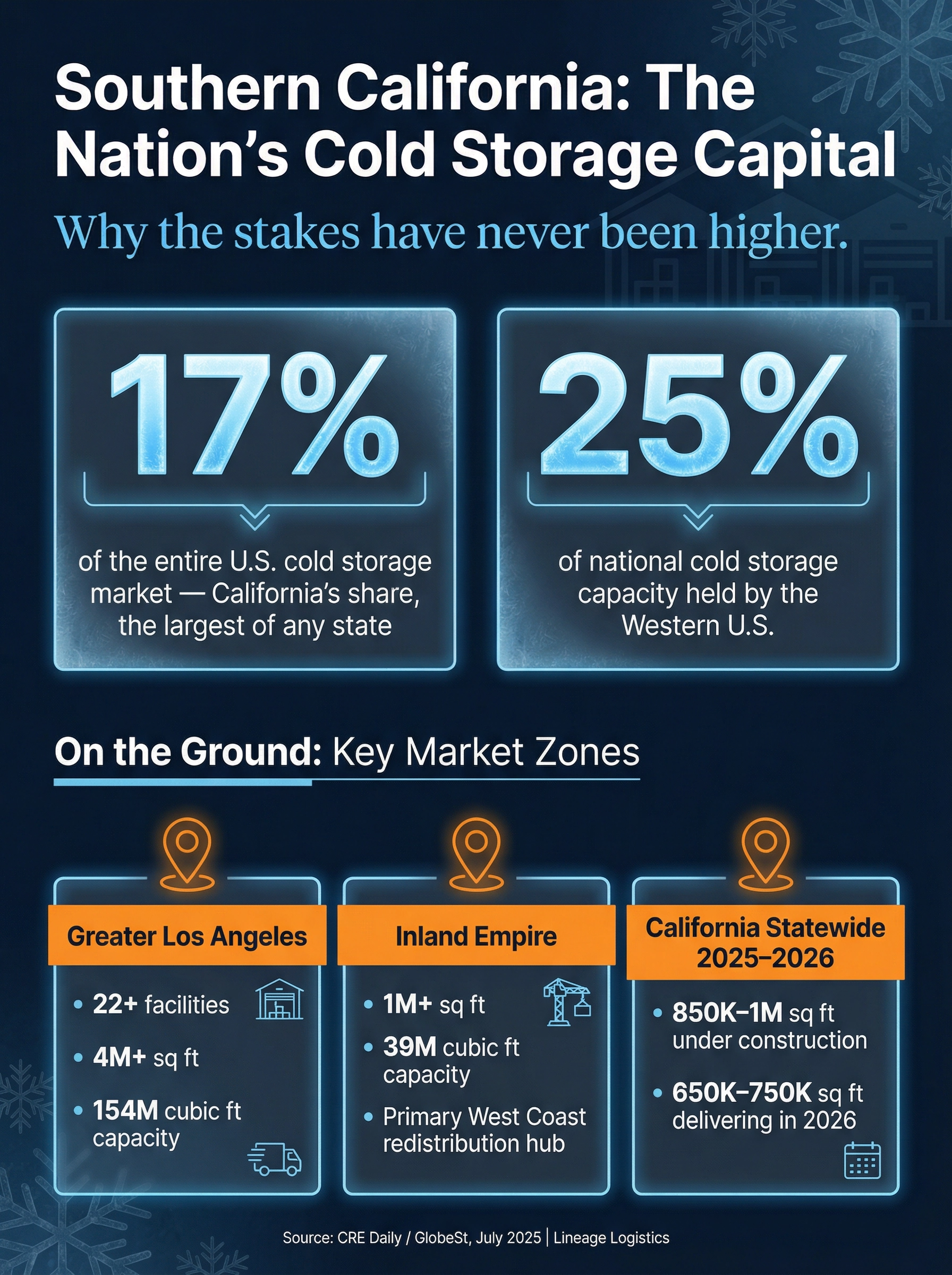
California holds
17% of the entire U.S. cold storage market, the largest share of any state in the country, according to a July 2025 report by CRE Daily and GlobeSt. The broader Western U.S. accounts for
25% of national cold storage capacity, and Southern California sits at the center of that network.
Here is what that looks like on the ground:
| Market Zone | Key Stats |
|---|---|
| Greater Los Angeles | Over 22 strategically located cold storage facilities in the LA metro area alone, with more than 4 million square feet of temperature-controlled storage and 154 million cubic feet of cold storage capacity |
| Inland Empire | Over 1 million square feet of dedicated cold storage space with 39 million cubic feet of capacity — the primary redistribution hub for West Coast retailers |
| California Statewide (2025–2026) | 850,000 to 1,000,000 sq ft currently under construction, with an additional 650,000 to 750,000 sq ft expected to deliver in 2026 |
Three major industry sectors are driving this growth: e-grocery (projected to reach 21.5% of total U.S. grocery sales, growing at 11.7% CAGR through 2027), pharmaceutical and life sciences (biologics, vaccines, and gene therapies requiring strict temperature control), and international trade through the Ports of Los Angeles and Long Beach — two of the busiest container ports in the Western Hemisphere.
Every single one of these facilities is required by California law to maintain a fully functional, annually tested fire alarm system that integrates correctly with its specialized fire suppression equipment. That is a significant compliance responsibility — and one that many property managers are not fully prepared for.
How Pre-Action Systems and Fire Alarms Work Together
To understand the compliance requirements, it helps to understand the mechanics in plain terms.
Think of a double interlock pre-action system as a highly secure vault that requires two separate "keys" to open. The vault contains the water needed to put out the fire, but it is kept safely away from the freezing temperatures of the warehouse floor.
- Key 1: The Fire Alarm System (Detection).
The first key is a signal from the fire alarm system. A heat detector or smoke detector in the freezer must sense a fire and send an electronic signal to the fire alarm control panel.
- Key 2: The Sprinkler Head (Heat). The second key is the physical melting of the glass bulb on the sprinkler head itself, caused by the heat of the fire. This releases the pressurized air inside the dry sprinkler pipes.
Only when
both keys are turned—the alarm detects the fire AND the sprinkler head opens—does the main valve release water into the pipes to extinguish the flames.
This double-failsafe design is brilliant because it prevents accidental water discharge. If a forklift accidentally knocks off a sprinkler head (Key 2), no water flows because the fire alarm (Key 1) hasn't detected a fire.
However, this also means your fire alarm system is the brain of the entire operation. If the alarm system is not properly integrated, tested, and maintained according to NFPA 72, your fire sprinklers are effectively useless.
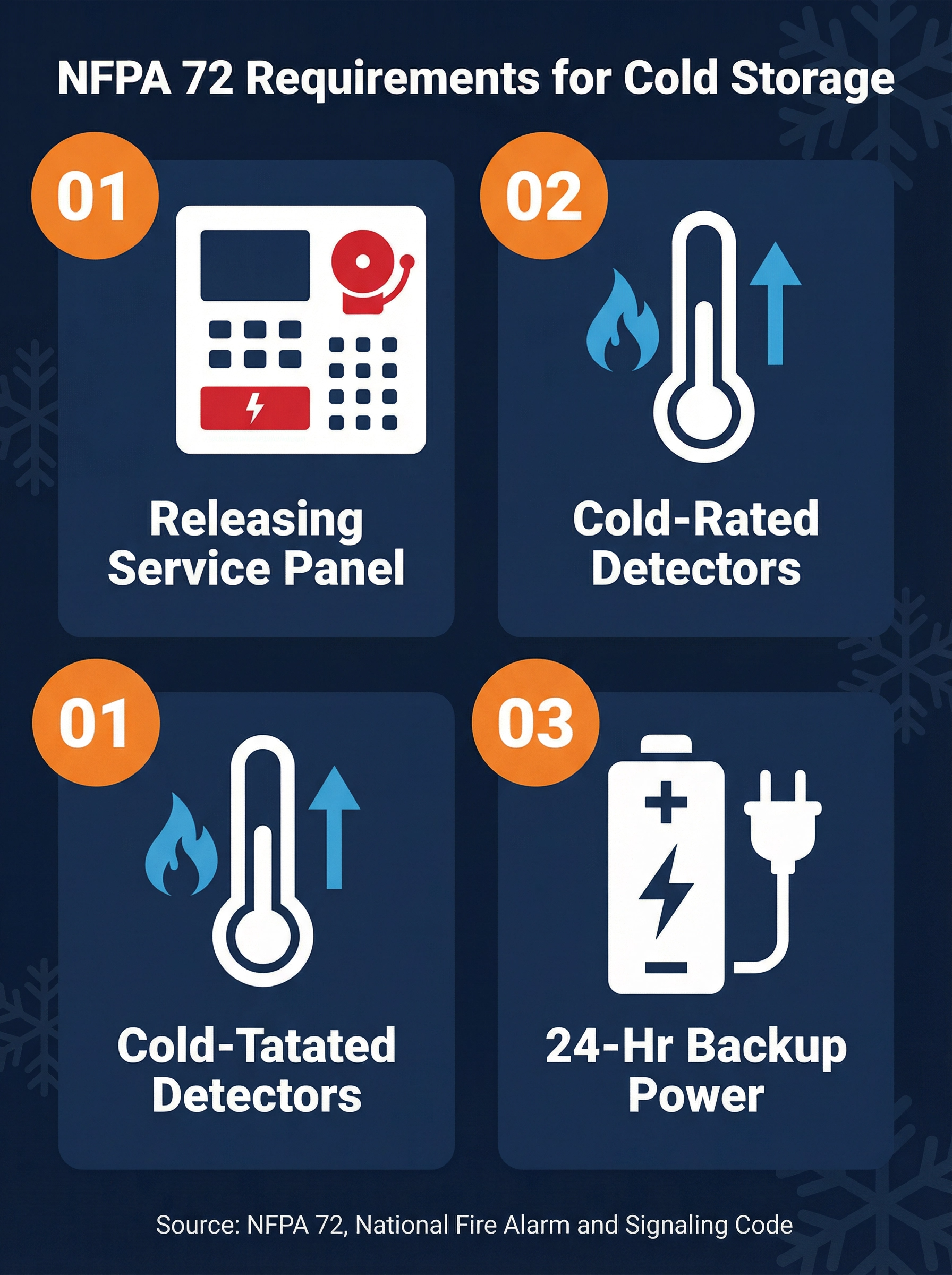
The National Fire Protection Association (NFPA) sets the standards that California adopts into law. When it comes to cold storage, NFPA 72 has specific requirements for how fire alarms must be installed and integrated.
1. Releasing Service Fire Alarm Control Units
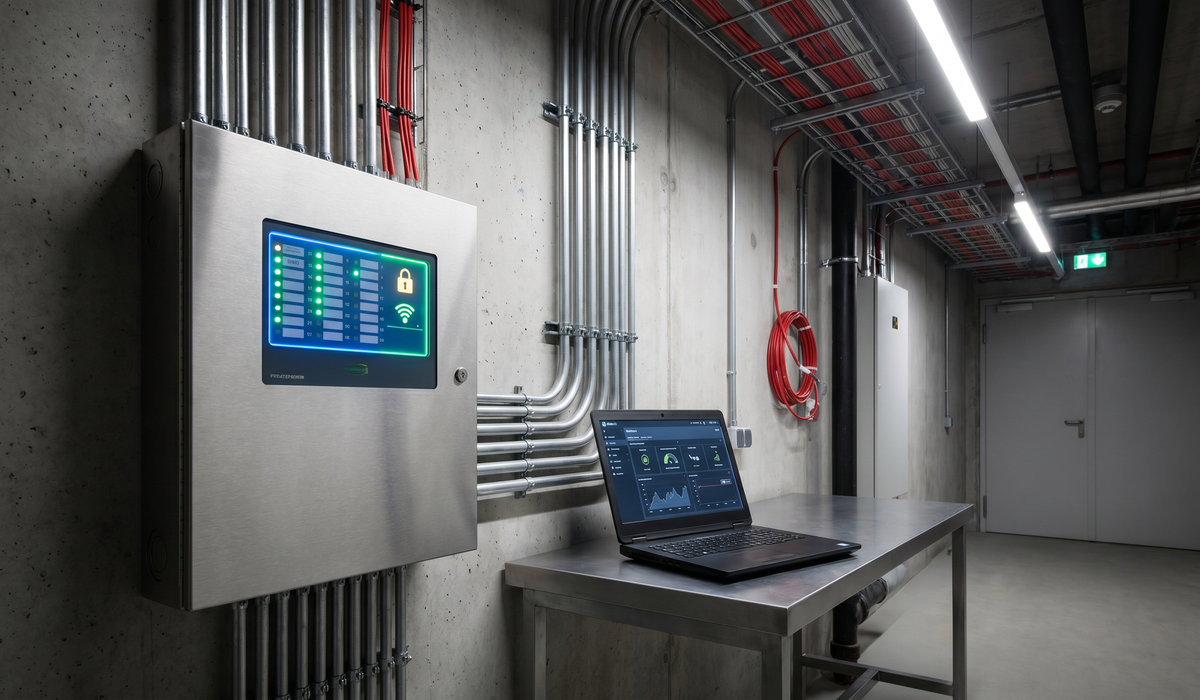
Not just any fire alarm panel can control a pre-action sprinkler system. According to NFPA 72, the fire alarm control unit must be specifically listed for "releasing service." This means the panel has been tested and certified to reliably send the critical signal that opens the pre-action water valve.
2. Specialized Detection Devices
Standard smoke detectors often fail in cold storage environments. The extreme cold, combined with condensation and frost, can cause false alarms or complete sensor failure. NFPA 72 requires that detection devices be rated for the specific environmental conditions where they are installed.
In many cold storage facilities, linear heat detection cables or specialized cold-rated spot heat detectors are used instead of traditional smoke detectors. These devices must be carefully selected and placed to ensure they detect a fire quickly enough to activate the pre-action valve before the fire spreads.
3. 24-Hour Backup Power
Because the fire alarm system controls the release of the fire sprinklers, NFPA 72 mandates strict backup power requirements. The fire alarm system, including the equipment used to monitor the pre-action valve, must have 24 hours of backup battery power to ensure the system remains operational during a power outage.
The California Compliance Calendar: Testing and Inspections
California law, enforced by local Authorities Having Jurisdiction (AHJs) like the Los Angeles Fire Department or the Orange County Fire Authority, requires rigorous testing of these integrated systems.
| Inspection Type | Frequency | What is Tested |
|---|---|---|
| Visual Inspection | Monthly / Quarterly | Checking panels for trouble signals, ensuring detectors are free of ice/frost buildup. |
| Functional Alarm Test | Annually | A full test of the fire alarm control panel, backup batteries, and notification appliances (horns/strobes). |
| Pre-Action Trip Test | Annually | Testing the integration between the fire alarm and the pre-action valve to ensure the valve opens when signaled. |
| Ice Plug Inspection | Annually | Checking the sprinkler piping where it enters the freezer for internal ice blockages (required by NFPA 25). |
Note: According to a 2026 NFPA technical brief, pre-action system trip testing is permitted to be completed in a manner that does not introduce water into the piping system, which is critical for freezer environments. [1]
Multifunction Properties and California Law
If your commercial portfolio includes mixed-use or multifunction properties—such as a cold storage distribution center attached to a large corporate office space, or a facility that includes both commercial operations and residential units—the compliance landscape becomes more complex.
Under California law, different occupancy types have different fire code requirements. However, the fire alarm systems for these mixed spaces must often be integrated. For example, a fire detected in the cold storage warehouse must trigger the appropriate alarms and evacuation protocols in the attached office building. Fire Testing Solutions specializes in navigating these complex, multi-zone integrations to ensure the entire property remains compliant.
For a broader overview of warehouse compliance, refer to our
Modern Warehouse Fire Safety Guide.
The Hidden Benefit: How Compliance Simplifies Operations
It is easy to view NFPA 72 compliance as a regulatory burden. But proactive maintenance of your integrated fire alarm and pre-action systems actually simplifies your life as a property manager.
When you partner with a professional fire protection company for regular Inspection, Testing, and Maintenance (ITM), you eliminate the stress of emergency repairs and the threat of unexpected fines. A well-maintained system prevents false alarms—which can disrupt your supply chain and lead to costly fire department response fees—and ensures that your facility is always ready for an unannounced inspection by the local fire marshal.
Compliance is not just about following the law; it is about operational predictability and peace of mind.
How Fire Testing Solutions Can Help
Navigating the intersection of NFPA 72 (fire alarms) and NFPA 25 (fire sprinklers) in a cold storage environment requires specialized expertise. Fire Testing Solutions is your dedicated compliance partner in Southern California.
We understand the unique challenges of cold storage facilities, from the Ports of Los Angeles to the Inland Empire. Our licensed technicians provide comprehensive services, including:
- Integrated System Testing:
We test both your fire alarm panel and your pre-action sprinkler valves simultaneously to ensure flawless communication.
- Cold-Environment Expertise: We know how to perform mandatory trip tests without introducing water into your freezer pipes.
- Deficiency Repairs: If we find an issue, we have the expertise to fix it quickly and keep you compliant.
- Complete Documentation: We provide the exact, detailed reports your local AHJ and insurance providers demand.
Frequently Asked Questions (FAQs)
1. Can my regular maintenance staff perform the annual fire alarm test?
No. California law requires that annual functional tests of fire alarm systems and pre-action sprinkler valves be performed by licensed fire protection professionals.
2. What happens if the fire alarm panel loses communication with the pre-action valve?
If communication is lost, the fire alarm panel will register a "trouble" or "supervisory" signal. This must be addressed immediately by a licensed technician, as the sprinkler system may not activate in the event of a fire.
3. Do we have to flow water into the freezer during the annual pre-action test?
No. Licensed technicians use specialized procedures to trip the pre-action valve and verify its operation without allowing water to enter the freezing environment, preventing pipe damage.
4. Are the fire code requirements the same across all of Southern California?
While the California Fire Code provides the baseline, local cities and counties (AHJs) can adopt stricter amendments. Your testing partner must be familiar with the specific requirements of your facility's location.
Conclusion
Protecting a cold storage facility in Southern California requires more than just installing a fire alarm; it requires seamless integration between the alarm system and specialized pre-action sprinklers. By understanding the requirements of NFPA 72, adhering to the strict annual testing calendar, and partnering with a specialized fire protection company, property managers can ensure their facilities remain safe, compliant, and fully operational.
Don't wait for a failed inspection or a system malfunction to address your fire alarm integration.
Ready to secure your compliance and simplify your property management?
- Book a call:
https://www.firetestingsolutions.com/contact
- Phone Number: 866-757-8378
- Email: service@firetestingsolutions.com
- Address: 700 W. First St, Suite 10, Tustin, CA 92780